

polymathic-ai/FNO-MHD_64
Updated • 107
Error code:   StreamingRowsError
Exception:    ValueError
Message:      Illegal slicing argument for scalar dataspace
Traceback:    Traceback (most recent call last):
                File "/src/services/worker/src/worker/utils.py", line 99, in get_rows_or_raise
                  return get_rows(
                         ^^^^^^^^^
                File "/src/libs/libcommon/src/libcommon/utils.py", line 272, in decorator
                  return func(*args, **kwargs)
                         ^^^^^^^^^^^^^^^^^^^^^
                File "/src/services/worker/src/worker/utils.py", line 77, in get_rows
                  rows_plus_one = list(itertools.islice(ds, rows_max_number + 1))
                                  ^^^^^^^^^^^^^^^^^^^^^^^^^^^^^^^^^^^^^^^^^^^^^^^
                File "/usr/local/lib/python3.12/site-packages/datasets/iterable_dataset.py", line 2543, in __iter__
                  for key, example in ex_iterable:
                                      ^^^^^^^^^^^
                File "/usr/local/lib/python3.12/site-packages/datasets/iterable_dataset.py", line 2060, in __iter__
                  for key, pa_table in self._iter_arrow():
                                       ^^^^^^^^^^^^^^^^^^
                File "/usr/local/lib/python3.12/site-packages/datasets/iterable_dataset.py", line 2083, in _iter_arrow
                  for key, pa_table in self.ex_iterable._iter_arrow():
                                       ^^^^^^^^^^^^^^^^^^^^^^^^^^^^^^
                File "/usr/local/lib/python3.12/site-packages/datasets/iterable_dataset.py", line 544, in _iter_arrow
                  for key, pa_table in iterator:
                                       ^^^^^^^^
                File "/usr/local/lib/python3.12/site-packages/datasets/iterable_dataset.py", line 383, in _iter_arrow
                  for key, pa_table in self.generate_tables_fn(**gen_kwags):
                                       ^^^^^^^^^^^^^^^^^^^^^^^^^^^^^^^^^^^^
                File "/usr/local/lib/python3.12/site-packages/datasets/packaged_modules/hdf5/hdf5.py", line 87, in _generate_tables
                  pa_table = _recursive_load_arrays(h5, self.info.features, start, end)
                             ^^^^^^^^^^^^^^^^^^^^^^^^^^^^^^^^^^^^^^^^^^^^^^^^^^^^^^^^^^
                File "/usr/local/lib/python3.12/site-packages/datasets/packaged_modules/hdf5/hdf5.py", line 273, in _recursive_load_arrays
                  arr = _recursive_load_arrays(dset, features[path], start, end)
                        ^^^^^^^^^^^^^^^^^^^^^^^^^^^^^^^^^^^^^^^^^^^^^^^^^^^^^^^^
                File "/usr/local/lib/python3.12/site-packages/datasets/packaged_modules/hdf5/hdf5.py", line 275, in _recursive_load_arrays
                  arr = _load_array(dset, path, start, end)
                        ^^^^^^^^^^^^^^^^^^^^^^^^^^^^^^^^^^^
                File "/usr/local/lib/python3.12/site-packages/datasets/packaged_modules/hdf5/hdf5.py", line 242, in _load_array
                  arr = dset[start:end]
                        ~~~~^^^^^^^^^^^
                File "h5py/_objects.pyx", line 56, in h5py._objects.with_phil.wrapper
                File "h5py/_objects.pyx", line 57, in h5py._objects.with_phil.wrapper
                File "/usr/local/lib/python3.12/site-packages/h5py/_hl/dataset.py", line 879, in __getitem__
                  selection = sel2.select_read(fspace, args)
                              ^^^^^^^^^^^^^^^^^^^^^^^^^^^^^^
                File "/usr/local/lib/python3.12/site-packages/h5py/_hl/selections2.py", line 101, in select_read
                  return ScalarReadSelection(fspace, args)
                         ^^^^^^^^^^^^^^^^^^^^^^^^^^^^^^^^^
                File "/usr/local/lib/python3.12/site-packages/h5py/_hl/selections2.py", line 86, in __init__
                  raise ValueError("Illegal slicing argument for scalar dataspace")
              ValueError: Illegal slicing argument for scalar dataspace
Need help to make the dataset viewer work? Make sure to review how to configure the dataset viewer, and open a discussion for direct support.
YAML Metadata Warning:empty or missing yaml metadata in repo card
Check out the documentation for more information.
NOTE: This dataset is available in two different resolutions $256^3$ for MHD_256 and $64^3$ for MHD_64. The data was first generated at $256^3$ and then downsampled to $64^3$ after anti-aliasing with an ideal low-pass filter. The data is available in both resolutions.
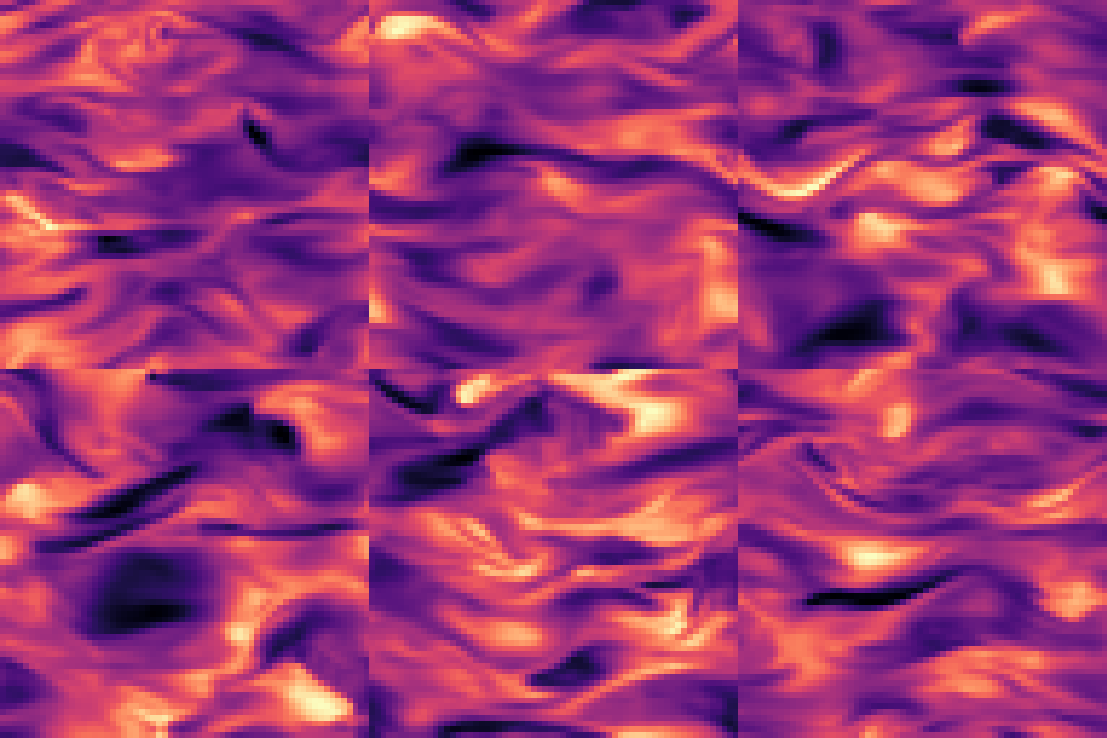
One line description of the data: This is an MHD fluid flows in the compressible limit (subsonic, supersonic, sub-Alfvenic, super-Alfvenic).
Longer description of the data: An essential component of the solar wind, galaxy formation, and of interstellar medium (ISM) dynamics is magnetohydrodynamic (MHD) turbulence. This dataset consists of isothermal MHD simulations without self-gravity (such as found in the diffuse ISM) initially generated with resolution $256^3$ and then downsampled to $64^3$ after anti-aliasing with an ideal low-pass filter. This dataset is the downsampled version.
Associated paper: Paper
Domain expert: Blakesley Burkhart, CCA, Flatiron Institute & Rutgers University.
Code or software used to generate the data: Fortran + MPI.
Equation:
where $\rho$ is the density, $\mathbf{v}$ is the velocity, $\mathbf{B}$ is the magnetic field, $\mathbf{I}$ the identity matrix and $p$ is the gas pressure.
| Dataset | FNO | TFNO | Unet | CNextU-net |
|---|---|---|---|---|
MHD_64 |
0.3605 | 3561 | 0.1798 | $\mathbf{0.1633}$ |
Table: VRMSE metrics on test sets (lower is better). Best results are shown in bold. VRMSE is scaled such that predicting the mean value of the target field results in a score of 1.
Dimension of discretized data: 100 timesteps of 64 $\times$ 64 $\times$ 64 cubes.
Fields available in the data: Density (scalar field), velocity (vector field), magnetic field (vector field).
Number of trajectories: 10 Initial conditions x 10 combination of parameters = 100 trajectories.
Estimated size of the ensemble of all simulations: 71.6 GB.
Grid type: uniform grid, cartesian coordinates.
Initial conditions: uniform IC.
Boundary conditions: periodic boundary conditions.
Data are stored separated by ($\Delta t$): 0.01 (arbitrary units).
Total time range ($t_{min}$ to $t_{max}$): $t_{min} = 0$, $t_{max} = 1$.
Spatial domain size ($L_x$, $L_y$, $L_z$): dimensionless so 64 pixels.
Set of coefficients or non-dimensional parameters evaluated: all combinations of $\mathcal{M}_s=${0.5, 0.7, 1.5, 2.0 7.0} and $\mathcal{M}_A =${0.7, 2.0}.
Approximate time and hardware used to generate the data: Downsampled from MHD_256 after applying ideal low-pass filter.
What phenomena of physical interest are catpured in the data: MHD fluid flows in the compressible limit (sub and super sonic, sub and super Alfvenic).
How to evaluate a new simulator operating in this space: Check metrics such as Power spectrum, two-points correlation function.
Please cite the associated paper if you use this data in your research:
@article{burkhart2020catalogue,
  title={The catalogue for astrophysical turbulence simulations (cats)},
  author={Burkhart, B and Appel, SM and Bialy, S and Cho, J and Christensen, AJ and Collins, D and Federrath, Christoph and Fielding, DB and Finkbeiner, D and Hill, AS and others},
  journal={The Astrophysical Journal},
  volume={905},
  number={1},
  pages={14},
  year={2020},
  publisher={IOP Publishing}
}
