
Transformers documentation
Swin2SR
This model was released on 2022-09-22 and added to Hugging Face Transformers on 2022-12-16.
Swin2SR

Overview
The Swin2SR model was proposed in Swin2SR: SwinV2 Transformer for Compressed Image Super-Resolution and Restoration by Marcos V. Conde, Ui-Jin Choi, Maxime Burchi, Radu Timofte. Swin2SR improves the SwinIR model by incorporating Swin Transformer v2 layers which mitigates issues such as training instability, resolution gaps between pre-training and fine-tuning, and hunger on data.
The abstract from the paper is the following:
Compression plays an important role on the efficient transmission and storage of images and videos through band-limited systems such as streaming services, virtual reality or videogames. However, compression unavoidably leads to artifacts and the loss of the original information, which may severely degrade the visual quality. For these reasons, quality enhancement of compressed images has become a popular research topic. While most state-of-the-art image restoration methods are based on convolutional neural networks, other transformers-based methods such as SwinIR, show impressive performance on these tasks. In this paper, we explore the novel Swin Transformer V2, to improve SwinIR for image super-resolution, and in particular, the compressed input scenario. Using this method we can tackle the major issues in training transformer vision models, such as training instability, resolution gaps between pre-training and fine-tuning, and hunger on data. We conduct experiments on three representative tasks: JPEG compression artifacts removal, image super-resolution (classical and lightweight), and compressed image super-resolution. Experimental results demonstrate that our method, Swin2SR, can improve the training convergence and performance of SwinIR, and is a top-5 solution at the “AIM 2022 Challenge on Super-Resolution of Compressed Image and Video”.
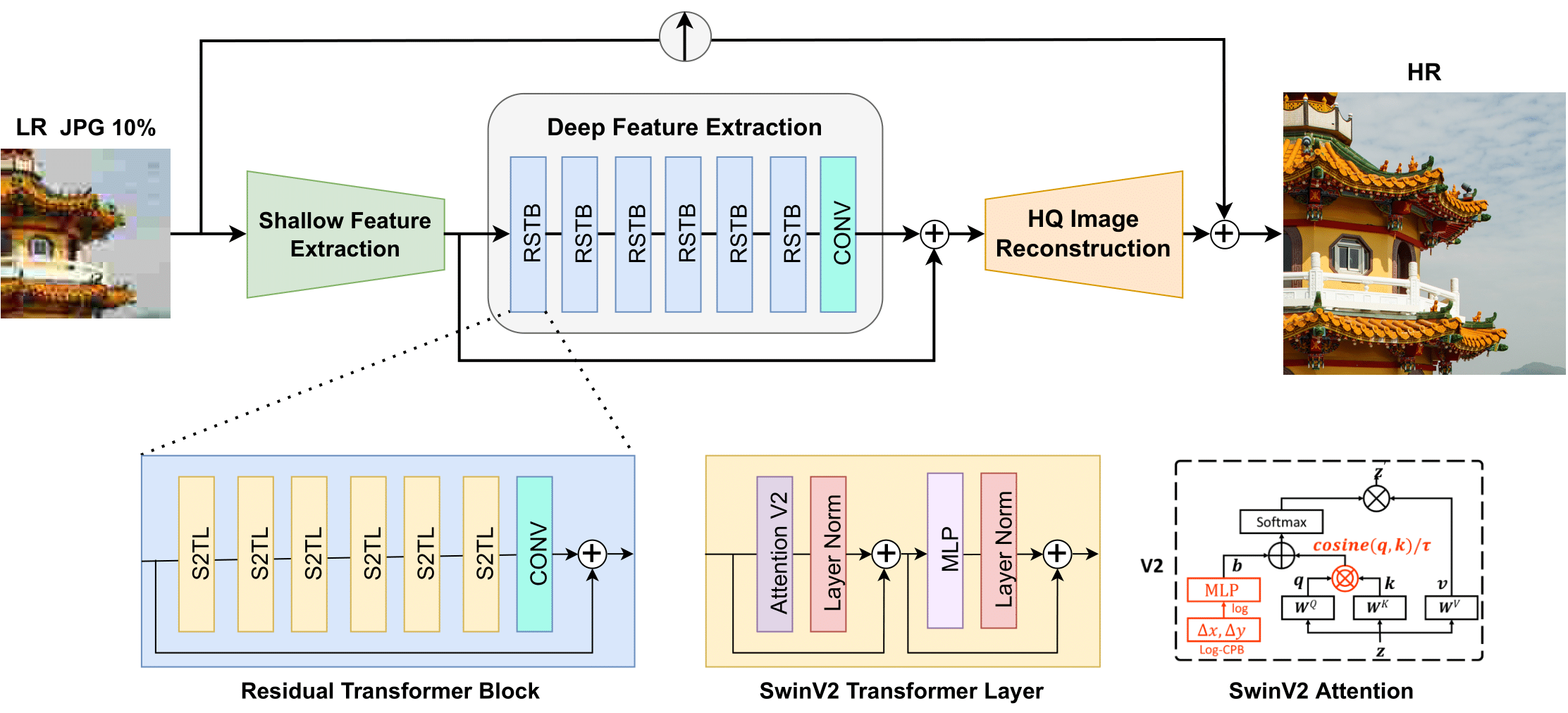 Swin2SR architecture. Taken from the original paper.
 This model was contributed by nielsr. The original code can be found here.
Resources
Demo notebooks for Swin2SR can be found here.
A demo Space for image super-resolution with SwinSR can be found here.
Swin2SRImageProcessor
class transformers.Swin2SRImageProcessor
< source >( **kwargs: typing_extensions.Unpack[transformers.models.swin2sr.image_processing_swin2sr.Swin2SRImageProcessorKwargs] )
Parameters
- size_divisor (
int, kwargs, optional, defaults toself.size_divisor) — The size to make the height and width divisible by when padding. - **kwargs (ImagesKwargs, optional) — Additional image preprocessing options. Model-specific kwargs are listed above; see the TypedDict class for the complete list of supported arguments.
Constructs a Swin2SRImageProcessor image processor.
preprocess
< source >( images: typing.Union[ForwardRef('PIL.Image.Image'), numpy.ndarray, ForwardRef('torch.Tensor'), list['PIL.Image.Image'], list[numpy.ndarray], list['torch.Tensor']] **kwargs: typing_extensions.Unpack[transformers.models.swin2sr.image_processing_swin2sr.Swin2SRImageProcessorKwargs] ) → ~image_processing_base.BatchFeature
Parameters
- images (
Union[PIL.Image.Image, numpy.ndarray, torch.Tensor, list[PIL.Image.Image], list[numpy.ndarray], list[torch.Tensor]]) — Image to preprocess. Expects a single or batch of images with pixel values ranging from 0 to 255. If passing in images with pixel values between 0 and 1, setdo_rescale=False. - size_divisor (
int, kwargs, optional, defaults toself.size_divisor) — The size to make the height and width divisible by when padding. - return_tensors (
stror TensorType, optional) — Returns stacked tensors if set to'pt', otherwise returns a list of tensors. - **kwargs (ImagesKwargs, optional) — Additional image preprocessing options. Model-specific kwargs are listed above; see the TypedDict class for the complete list of supported arguments.
Returns
~image_processing_base.BatchFeature
- data (
dict) — Dictionary of lists/arrays/tensors returned by the call method (‘pixel_values’, etc.). - tensor_type (
Union[None, str, TensorType], optional) — You can give a tensor_type here to convert the lists of integers in PyTorch/Numpy Tensors at initialization.
Swin2SRImageProcessorPil
class transformers.Swin2SRImageProcessorPil
< source >( **kwargs: typing_extensions.Unpack[transformers.models.swin2sr.image_processing_pil_swin2sr.Swin2SRImageProcessorKwargs] )
Parameters
- size_divisor (
int, kwargs, optional, defaults toself.size_divisor) — The size to make the height and width divisible by when padding. - **kwargs (ImagesKwargs, optional) — Additional image preprocessing options. Model-specific kwargs are listed above; see the TypedDict class for the complete list of supported arguments.
Constructs a Swin2SRImageProcessor image processor.
preprocess
< source >( images: typing.Union[ForwardRef('PIL.Image.Image'), numpy.ndarray, ForwardRef('torch.Tensor'), list['PIL.Image.Image'], list[numpy.ndarray], list['torch.Tensor']] **kwargs: typing_extensions.Unpack[transformers.models.swin2sr.image_processing_pil_swin2sr.Swin2SRImageProcessorKwargs] ) → ~image_processing_base.BatchFeature
Parameters
- images (
Union[PIL.Image.Image, numpy.ndarray, torch.Tensor, list[PIL.Image.Image], list[numpy.ndarray], list[torch.Tensor]]) — Image to preprocess. Expects a single or batch of images with pixel values ranging from 0 to 255. If passing in images with pixel values between 0 and 1, setdo_rescale=False. - size_divisor (
int, kwargs, optional, defaults toself.size_divisor) — The size to make the height and width divisible by when padding. - return_tensors (
stror TensorType, optional) — Returns stacked tensors if set to'pt', otherwise returns a list of tensors. - **kwargs (ImagesKwargs, optional) — Additional image preprocessing options. Model-specific kwargs are listed above; see the TypedDict class for the complete list of supported arguments.
Returns
~image_processing_base.BatchFeature
- data (
dict) — Dictionary of lists/arrays/tensors returned by the call method (‘pixel_values’, etc.). - tensor_type (
Union[None, str, TensorType], optional) — You can give a tensor_type here to convert the lists of integers in PyTorch/Numpy Tensors at initialization.
Swin2SRConfig
class transformers.Swin2SRConfig
< source >( transformers_version: str | None = None architectures: list[str] | None = None output_hidden_states: bool | None = False return_dict: bool | None = True dtype: typing.Union[str, ForwardRef('torch.dtype'), NoneType] = None chunk_size_feed_forward: int = 0 is_encoder_decoder: bool = False id2label: dict[int, str] | dict[str, str] | None = None label2id: dict[str, int] | dict[str, str] | None = None problem_type: typing.Optional[typing.Literal['regression', 'single_label_classification', 'multi_label_classification']] = None image_size: int | list[int] | tuple[int, int] = 64 patch_size: int | list[int] | tuple[int, int] = 1 num_channels: int = 3 num_channels_out: int | None = None embed_dim: int = 180 depths: list[int] | tuple[int, ...] = (6, 6, 6, 6, 6, 6) num_heads: list[int] | tuple[int, ...] = (6, 6, 6, 6, 6, 6) window_size: int = 8 mlp_ratio: float = 2.0 qkv_bias: bool = True hidden_dropout_prob: float | int = 0.0 attention_probs_dropout_prob: float | int = 0.0 drop_path_rate: float | int = 0.1 hidden_act: str = 'gelu' use_absolute_embeddings: bool = False initializer_range: float = 0.02 layer_norm_eps: float = 1e-05 upscale: int = 2 img_range: float = 1.0 resi_connection: str = '1conv' upsampler: str = 'pixelshuffle' )
Parameters
- image_size (
Union[int, list[int], tuple[int, int]], optional, defaults to64) — The size (resolution) of each image. - patch_size (
Union[int, list[int], tuple[int, int]], optional, defaults to1) — The size (resolution) of each patch. - num_channels (
int, optional, defaults to3) — The number of input channels. - num_channels_out (
int, optional, defaults tonum_channels) — The number of output channels. If not set, it will be set tonum_channels. - embed_dim (
int, optional, defaults to180) — Dimensionality of the embeddings and hidden states. - depths (
list(int), optional, defaults to[6, 6, 6, 6, 6, 6]) — Depth of each layer in the Transformer encoder. - num_heads (
list(int), optional, defaults to[6, 6, 6, 6, 6, 6]) — Number of attention heads in each layer of the Transformer encoder. - window_size (
int, optional, defaults to 8) — Size of windows. - mlp_ratio (
float, optional, defaults to2.0) — Ratio of the MLP hidden dim to the embedding dim. - qkv_bias (
bool, optional, defaults toTrue) — Whether to add a bias to the queries, keys and values. - hidden_dropout_prob (
Union[float, int], optional, defaults to0.0) — The dropout probability for all fully connected layers in the embeddings, encoder, and pooler. - attention_probs_dropout_prob (
Union[float, int], optional, defaults to0.0) — The dropout ratio for the attention probabilities. - drop_path_rate (
Union[float, int], optional, defaults to0.1) — Drop path rate for the patch fusion. - hidden_act (
str, optional, defaults togelu) — The non-linear activation function (function or string) in the decoder. For example,"gelu","relu","silu", etc. - use_absolute_embeddings (
bool, optional, defaults toFalse) — Whether to use absolute position embeddings. - initializer_range (
float, optional, defaults to0.02) — The standard deviation of the truncated_normal_initializer for initializing all weight matrices. - layer_norm_eps (
float, optional, defaults to1e-05) — The epsilon used by the layer normalization layers. - upscale (
int, optional, defaults to 2) — The upscale factor for the image. 2/3/4/8 for image super resolution, 1 for denoising and compress artifact reduction - img_range (
float, optional, defaults to 1.0) — The range of the values of the input image. - resi_connection (
str, optional, defaults to"1conv") — The convolutional block to use before the residual connection in each stage. - upsampler (
str, optional, defaults to"pixelshuffle") — The reconstruction reconstruction module. Can be ‘pixelshuffle’/‘pixelshuffledirect’/‘nearest+conv’/None.
This is the configuration class to store the configuration of a Swin2SRModel. It is used to instantiate a Swin2Sr model according to the specified arguments, defining the model architecture. Instantiating a configuration with the defaults will yield a similar configuration to that of the caidas/swin2sr-classicalsr-x2-64
Configuration objects inherit from PreTrainedConfig and can be used to control the model outputs. Read the documentation from PreTrainedConfig for more information.
Example:
>>> from transformers import Swin2SRConfig, Swin2SRModel

>>> # Initializing a Swin2SR caidas/swin2sr-classicalsr-x2-64 style configuration
>>> configuration = Swin2SRConfig()

>>> # Initializing a model (with random weights) from the caidas/swin2sr-classicalsr-x2-64 style configuration
>>> model = Swin2SRModel(configuration)

>>> # Accessing the model configuration
>>> configuration = model.config
Swin2SRModel
class transformers.Swin2SRModel
< source >( config )
Parameters
- config (Swin2SRModel) — Model configuration class with all the parameters of the model. Initializing with a config file does not load the weights associated with the model, only the configuration. Check out the from_pretrained() method to load the model weights.
The bare Swin2Sr Model outputting raw hidden-states without any specific head on top.
This model inherits from PreTrainedModel. Check the superclass documentation for the generic methods the library implements for all its model (such as downloading or saving, resizing the input embeddings, pruning heads etc.)
This model is also a PyTorch torch.nn.Module subclass. Use it as a regular PyTorch Module and refer to the PyTorch documentation for all matter related to general usage and behavior.
forward
< source >( pixel_values: FloatTensor output_attentions: bool | None = None output_hidden_states: bool | None = None return_dict: bool | None = None **kwargs ) → BaseModelOutput or tuple(torch.FloatTensor)
Parameters
- pixel_values (
torch.FloatTensorof shape(batch_size, num_channels, image_size, image_size)) — The tensors corresponding to the input images. Pixel values can be obtained using Swin2SRImageProcessor. SeeSwin2SRImageProcessor.__call__()for details (processor_classuses Swin2SRImageProcessor for processing images). - output_attentions (
bool, optional) — Whether or not to return the attentions tensors of all attention layers. Seeattentionsunder returned tensors for more detail. - output_hidden_states (
bool, optional) — Whether or not to return the hidden states of all layers. Seehidden_statesunder returned tensors for more detail. - return_dict (
bool, optional) — Whether or not to return a ModelOutput instead of a plain tuple.
Returns
BaseModelOutput or tuple(torch.FloatTensor)
A BaseModelOutput or a tuple of
torch.FloatTensor (if return_dict=False is passed or when config.return_dict=False) comprising various
elements depending on the configuration (Swin2SRConfig) and inputs.
The Swin2SRModel forward method, overrides the __call__ special method.
Although the recipe for forward pass needs to be defined within this function, one should call the
Moduleinstance afterwards instead of this since the former takes care of running the pre and post processing steps while the latter silently ignores them.
last_hidden_state (
torch.FloatTensorof shape(batch_size, sequence_length, hidden_size)) — Sequence of hidden-states at the output of the last layer of the model.hidden_states (
tuple(torch.FloatTensor), optional, returned whenoutput_hidden_states=Trueis passed or whenconfig.output_hidden_states=True) — Tuple oftorch.FloatTensor(one for the output of the embeddings, if the model has an embedding layer, + one for the output of each layer) of shape(batch_size, sequence_length, hidden_size).Hidden-states of the model at the output of each layer plus the optional initial embedding outputs.
attentions (
tuple(torch.FloatTensor), optional, returned whenoutput_attentions=Trueis passed or whenconfig.output_attentions=True) — Tuple oftorch.FloatTensor(one for each layer) of shape(batch_size, num_heads, sequence_length, sequence_length).Attentions weights after the attention softmax, used to compute the weighted average in the self-attention heads.
Swin2SRForImageSuperResolution
class transformers.Swin2SRForImageSuperResolution
< source >( config )
Parameters
- config (Swin2SRForImageSuperResolution) — Model configuration class with all the parameters of the model. Initializing with a config file does not load the weights associated with the model, only the configuration. Check out the from_pretrained() method to load the model weights.
Swin2SR Model transformer with an upsampler head on top for image super resolution and restoration.
This model inherits from PreTrainedModel. Check the superclass documentation for the generic methods the library implements for all its model (such as downloading or saving, resizing the input embeddings, pruning heads etc.)
This model is also a PyTorch torch.nn.Module subclass. Use it as a regular PyTorch Module and refer to the PyTorch documentation for all matter related to general usage and behavior.
forward
< source >( pixel_values: torch.FloatTensor | None = None labels: torch.LongTensor | None = None output_attentions: bool | None = None output_hidden_states: bool | None = None return_dict: bool | None = None **kwargs ) → ImageSuperResolutionOutput or tuple(torch.FloatTensor)
Parameters
- pixel_values (
torch.FloatTensorof shape(batch_size, num_channels, image_size, image_size), optional) — The tensors corresponding to the input images. Pixel values can be obtained using Swin2SRImageProcessor. SeeSwin2SRImageProcessor.__call__()for details (processor_classuses Swin2SRImageProcessor for processing images). - labels (
torch.LongTensorof shape(batch_size, sequence_length), optional) — Labels for computing the masked language modeling loss. Indices should either be in[0, ..., config.vocab_size]or -100 (seeinput_idsdocstring). Tokens with indices set to-100are ignored (masked), the loss is only computed for the tokens with labels in[0, ..., config.vocab_size]. - output_attentions (
bool, optional) — Whether or not to return the attentions tensors of all attention layers. Seeattentionsunder returned tensors for more detail. - output_hidden_states (
bool, optional) — Whether or not to return the hidden states of all layers. Seehidden_statesunder returned tensors for more detail. - return_dict (
bool, optional) — Whether or not to return a ModelOutput instead of a plain tuple.
Returns
ImageSuperResolutionOutput or tuple(torch.FloatTensor)
A ImageSuperResolutionOutput or a tuple of
torch.FloatTensor (if return_dict=False is passed or when config.return_dict=False) comprising various
elements depending on the configuration (Swin2SRConfig) and inputs.
The Swin2SRForImageSuperResolution forward method, overrides the __call__ special method.
Although the recipe for forward pass needs to be defined within this function, one should call the
Moduleinstance afterwards instead of this since the former takes care of running the pre and post processing steps while the latter silently ignores them.
loss (
torch.FloatTensorof shape(1,), optional, returned whenlabelsis provided) — Reconstruction loss.reconstruction (
torch.FloatTensorof shape(batch_size, num_channels, height, width)) — Reconstructed images, possibly upscaled.hidden_states (
tuple(torch.FloatTensor), optional, returned whenoutput_hidden_states=Trueis passed or whenconfig.output_hidden_states=True) — Tuple oftorch.FloatTensor(one for the output of the embeddings, if the model has an embedding layer, + one for the output of each stage) of shape(batch_size, sequence_length, hidden_size). Hidden-states (also called feature maps) of the model at the output of each stage.attentions (
tuple(torch.FloatTensor), optional, returned whenoutput_attentions=Trueis passed or whenconfig.output_attentions=True) — Tuple oftorch.FloatTensor(one for each layer) of shape(batch_size, num_heads, patch_size, sequence_length).Attentions weights after the attention softmax, used to compute the weighted average in the self-attention heads.
Example:
>>> import torch
>>> import numpy as np
>>> from PIL import Image
>>> import httpx
>> from io import BytesIO

>>> from transformers import AutoImageProcessor, Swin2SRForImageSuperResolution

>>> processor = AutoImageProcessor.from_pretrained("caidas/swin2SR-classical-sr-x2-64")
>>> model = Swin2SRForImageSuperResolution.from_pretrained("caidas/swin2SR-classical-sr-x2-64")

>>> url = "https://huggingface.co/spaces/jjourney1125/swin2sr/resolve/main/samples/butterfly.jpg"
>>> with httpx.stream("GET", url) as response:
...     image = Image.open(BytesIO(response.read()))
>>> # prepare image for the model
>>> inputs = processor(image, return_tensors="pt")

>>> # forward pass
>>> with torch.no_grad():
...     outputs = model(**inputs)

>>> output = outputs.reconstruction.data.squeeze().float().cpu().clamp_(0, 1).numpy()
>>> output = np.moveaxis(output, source=0, destination=-1)
>>> output = (output * 255.0).round().astype(np.uint8)  # float32 to uint8
>>> # you can visualize `output` with `Image.fromarray`